| Home | Central America and Mexico | South America | Caribbean | Europe | Africa | Middle East | Asia | Australia and The Pacific Islands |
1881:
Start of the first great aliya, or mass immigration of Jews to the Holy Land. There had always been a Jewish population - much smaller than the Palestinian one - and over the centuries there had been sporadic immigration of Jews from the diaspora.
But 1881 marked the first organised movement back to Eretz Yisrael, the land of Israel. The first olim (literally, the ascenders) came from Russia and Yemen. The movement greatly accelerated during and after vicious pogroms against the Jews of Russia and Romania.
In 1881, the Jewish population of what is now Israel numbered around 24,000. In the following 20 years, it is estimated that 30-40,000 Jewish immigrants arrived. During the period, the land was ruled by the Ottoman Turks, who called it Palestine and regarded it as part of southern Syria. It was administratively divided into three parts. [1]
1896:
Publication of Der Judenstaat, The Jewish State, by Theodor Herzl, the founding father of the Zionist movement. The book was received with derision by leading European Jews, but struck an immediate chord with those who were regularly persecuted and vilified. [1]
1897:
First Zionist congress, in Basle. Jewish delegates from across Europe accept the notion of a national homeland, though they are less clear about where it should be and how it can be achieved. The seeds are sown for the World Zionist Organisation. [1]
1916:
The Sykes-Picot agreement. In the midst of the first world war, with millions dying on the western front, the imperially-minded French and British governments reach an understanding on how the Middle East should be carved, post war, into zones of influence. [1] [12]
1917:
November - The Balfour declaration. A masterpiece of political obfuscation, in which the British foreign minister Arthur Balfour, writing to Lord Rothschild of the World Zionist Organisation, promises all things to all men: "His Majesty's Government view with favour the establishment in Palestine of a national home for the Jewish people, and will use their best endeavours to facilitate the achievement of this object, it being clearly understood that nothing shall be done which may prejudice the civil and religious rights of existing non-Jewish communities in Palestine, or the rights and political status enjoyed by Jews in any other country." [1] [12]
December - British forces take Jerusalem from the Turks. [12]
1918:
October - An armistice is concluded with Turkey and all of Palestine comes under British rule. [12]
1919:
Ben Gurion founds the first united Labour Zionist party. [12]
1920:
March - A General Syrian Congress meeting in Damascus elects Faysal king of a united Syria, which includes Palestine. This raises the hope of the Palestinian Arab population that the Balfour Declaration will be rescinded, setting off a feverish series of demonstrations in Palestine in the spring. But Faysal is ousted by the French in the summer. [12]
Under the terms of the Versailles peace conference, Britain is mandated to govern what is now Israel, the occupied territories and Jordan. [1]
Herbert Samuel, a former Liberal cabinet minister and prominent British Jew, becomes first High Commissioner. The mandate requires Britain to implement the Balfour declaration, and stipulates that the civil power should "facilitate Jewish immigration under suitable conditions and shall encourage close settlement by Jews on the land". [1]
Ben Gurion forms the Histadrut, a labour union designed to form an autonomous Jewish economic state within the Palestinian economy. [12]
The Jewish population of the Holy Land had shrunk to some 60,000 during the last years of Turkish rule. The postwar years saw renewed immigration, with some 35,000 people arriving from Europe and America in the years 1919-23. To the alarm of the existing Arab population, the Zionist movement was now acquiring teeth: 1920 saw the foundation of the armed Jewish protection movement, the Haganah. [1] [12]
1921:
Samuels grants important governing roles in Palestine to two rival families, the Husseinis and the Nashahibis. This fragments Palestinian leadership, weakening their resistance to the Zionist movement. [12]
Also many Arabs sell land to Jewish settlers for easy profits. [12]
1922:
The League of Nations adopt the Balfour declaration, and leaves Britain in charge of Palestine, and in assisting the Jews in "reconstituting their national home in that country". Jews represent 11% of the population in Palestine with their 85,000, compared to the 670,000 Palestinians. [2] [12]
The Zionists can not openly oppose the establishment of democratic structures, which is clearly in accordance with the Covenant of the League of Nations and the mandatory system. The Arabs of Palestine, however, believing that participation in Mandate-sanctioned institutions will signify their acquiescence to the Mandate and thus to the Balfour Declaration, refuse to participate. As a result, Samuels' proposals for a legislative council, an advisory council, and an Arab agency envisioned as similar to the Jewish Agency, are all rejected by the Arabs. After the collapse of the bid for representative institutions, any possibility of joint consultation between the two communities ends. [12]
The first British white paper on Palestine. The territory is divided into two administrative districts. The larger, eastern, part of the mandated territory is to be known as Transjordan. It is given a measure of autonomy under its new Hashemite emir, Abdullah, who had been expelled from Saudi Arabia. To the rage of militant Zionists, the British dictate that Jews will be permitted to settle only to the west of the Jordan rift valley. [1]
Jewish land ownership at this time totals about 60,120 hectares. [12]
1924:
In the mid-1920s, a political and economic crisis in Poland and the Johnson-Lodge Immigration Act passed by the United States Congress, which curtails mass immigration to America, spurs Polish-Jewish immigration to Israel. Between 1924 and 1931, approximately 80,000 Jews arrive in Palestine from Central Europe. Not attracted to the Labor Party's collective settlements, they migrate to the cities where they establish the first semblance of an industrialized urban Jewish economy in Palestine. Within five years, the Jewish populations of Jerusalem and Haifa double, and the city of Tel Aviv emerges. [12]
1925:
The Hebrew University of Jerusalem is dedicated. [12]
1929:
The World Zionist Organisation formally establishes the Jewish Agency, to aid in the establishment of a Jewish homeland and organise the immigration of Jews to it. [12]
Alarmed by the rapid expansion of Jewish settlement, Arabs riot in many areas. More than 130 Jews are killed. The riots are a precursor to a more bloody Arab uprising in 1936, in which Palestinian and Jewish paramilitary groups clash for the first time. The latter are aided to victory by a young, fanatically Christian and Zionist army officer, Orde Wingate. [1] [12]
The inactivity of the British while Arab bands are attacking Jewish settlers strengthens Zionist anti-British forces. [12]
1930's:
With Palestine beset by a severe economic depression, large numbers of Arab peasants, unable to pay either their Arab landlords or taxes to the government, sell their land. The British do not intervene in the land purchases mainly because they need the influx of Jewish capital to pay for Jewish social services and to maintain the Jewish economy. [12]
When, in January 1930, Adolf Hitler becomes chancellor of the Reich a massive wave of mostly German Jewish immigration to Palestine ensues. Recorded Jewish immigration is 37,000 in 1933, 45,000 in 1934, and 61,000 in 1935. In addition, the British estimate that a total of 40,000 Jews enter Palestine without legal certificates during the period from 1920 to 1939. [12]
1930:
Following the 1929 riots, the British set up the Shaw Commission to determine the cause of the disturbances. The commission report refrains from blaming either community but focuses on Arab apprehensions about Jewish labour practices and land purchases. The commission's allegations are investigated by an agrarian expert, Sir John Hope Simpson, who concludes that about 30 percent of the Arab population is already landless and that the amount of land remaining in Arab hands will be insufficient to divide among their offspring. This leads to the Passfield White Paper (October 1930), which recommends that Jewish immigration be stopped if it prevents Arabs from obtaining employment and that Jewish land purchases be curtailed. The Passfield White Paper is publicly repudiated by Prime Minister Ramsay MacDonald in 1931, but it still serves to alienate further the Jewish community from the British. [12]
1931:
The inability of the Haganah to protect Jewish civilians during the 1929 riots leads Jewish Polish immigrants who support Jabotinsky to break away from the Labour-dominated Haganah. The first Betar congress meets at Danzig in 1931 and elects Jabotinsky as its leader. [12]
1936:
An Arab Higher Committee (AHC), a loose coalition of recently formed Arab political parties, is created. It declares a national strike in support of three basic demands: cessation of Jewish immigration, an end to all further land sales to the Jews, and the establishment of an Arab national government. [12]
The intensity of the Palestinian Revolt, at a time when Britain is preparing for the possibility of another world war, leads the British to reorient their policy in Palestine. They pursue a policy of appeasement with respect to the Arabs. [12]
1937:
In the midst of the Palestinian uprising, the Peel commission suggests that the Holy Land be partitioned into Jewish and Arab zones. Neither group is happy with the proposal and the British Woodhead commission which, reporting in November, subsequently rejects it as impractical. [1] [12]
The Palestinian Revolt breaks out again in the autumn. The British put down the revolt using harsh measures, shutting down the AHC and deporting many Palestinian Arab leaders. With their leadership residing outside Palestine, the Arabs are unable to match the Zionists' highly sophisticated organization. [12]
A group of Haganah members leaves the organization in protest against its "defensive" orientation and joins forces with Betar to set up a new and more militant armed underground organization, known as the Irgun. [12]
1938:
Any lingering doubts about Nazi intentions in Germany is removed by the vicious savagery of Kristallnacht. [1]
1939:
May - A British White Paper proposes to establish a Palestinian state within ten years and limiting Jewish immigration to 75,000 entering Palestine over the next five years, after which all immigration will be subject to Arab consent; all further land sales will be severely restricted. Arab response is mixed and the Jewish Agency rejects it. At this time 450,000 Jews and 1,060,000 Arabs live in Palestine (30%). [2] [12]
Jewish land ownership at this time totals about 155,140 hectares. [12]
Outbreak of the second world war, and the dawning, sickening, realisation that Hitler is intent on a final solution of the Jewish issue - that is, genocide. [1]
An extreme terrorist group, known to the British as the Stern Gang, splits off from the Irgun. [12]
1940:
May - Winston Churchill, a zionist sympathizer, becomes prime minister of Britain. The British train Jewish commando units, the first elements of the Palmach (Pelugot Mahatz--Shock Forces) the strategic reserve of the Haganah. They also give Jewish volunteers intensive training in sabotage, demolition, and partisan warfare. Ironically, this training proves indispensable in the Jewish efforts after the war to force the British to withdraw from Palestine. [12]
As Italy enter the war, bringing it closer to the Middle East, the British enforce the strict limitations on Jewish immigration proposed previously, in order to avoid antagonizing the Arabs. [12]
1942:
April - The British turn the Struma, a ship carrying Jewish refugees from Romania, away from Palestine. It then sinks in the Black Sea and all but two of its passengers die. A young Menachem Begin then set about uniting the Jewish underground in preparation for a Jewish war of liberation against the British. [12]
The anti-Zionist trend in British policy causes the Zionists to increasing rely on the US and the US Jews. [12]
1943:
As news regarding Nazi persecution of Jews in Europe increases, the Irgun and Stern Gang stepped up harassment of British forces in an attempt to obtain unrestricted Jewish immigration. [12]
1944:
The militant Jewish underground group Irgun Zva'i Le'umi, under future prime minister Menachim Begin, tires of collaboration in the war effort, and declares war on the British rulers of Palestine. [1]
November - Lord Moyne, the British minister resident in Cairo and a close personal friend of Churchill, is assassinated by Lehi. Lord Moyne's assassination alienates the British prime minister, who until now has supported a Jewish national home in Palestine. Subsequently, no British government considers setting up a Jewish state in Palestine. The assassination also leads the Haganah to cooperate with the British against the Irgun. [12]
1945:
By the end of the war almost 6 million Jews from Europe have been killed of about 10 million who were living there. For many Jews Zionism and its call for a Jewish national home and for the radical transformation of the Jew from passive victim to self-sufficient citizen residing in his own homeland becomes the only possible positive response to the Holocaust. [12]
The British position in Palestine at the end of World War II is becoming increasingly untenable. Hundreds of thousands of Jewish Holocaust survivors temporarily housed in displaced persons camps in Europe are clamouring to be settled in Palestine. The fate of these refugees arouses international public opinion against British policy. Moreover, the administration of President Harry S Truman, feeling morally bound to help the Jewish refugees and exhorted by a large and vocal Jewish community, pressures Britain to change its course in Palestine. Postwar Britain depends on American economic aid to reconstruct its war-torn economy. Furthermore, Britain's staying power in its old colonial holdings is waning. [12]
October - Under Ben-Gurion's direction, the Jewish Agency decides to unite with Jewish dissident groups in a combined rebellion against the British administration in Palestine. The combined Jewish resistance movement organizes illegal immigration and kidnapping of British officials in Palestine and sabotages the British infrastructure in Palestine. In response the British order a crackdown on the Haganah and arrested many of its leaders. While the British concentrate their efforts on the Haganah, the Irgun and Lehi carry out terrorist attacks against British forces. [12]
The Zionist movement is clandestinely aided by the French government. [166]
1946:
May - the Anglo-American Committee of Inquiry unanimously declares its opposition to the White Paper of 1939 and proposes, among other recommendations, that the immigration to Palestine of 100,000 European Jews be authorized at once. The British Mandate Authority rejects the proposal, stating that such immigration is impossible while armed organizations in Palestine, both Arab and Jewish, are fighting the authority and disrupting public order. [12]
Britain grants independence to Transjordan, which becomes the kingdom of Jordan. [1]
July - Jewish dissidents bomb the King David Hotel in Jerusalem. [1] [12] It is believed that Menachem Begin's Irgun group carried out the attack. They also make plans to assassinate Ernest Bevin, the British foreign secretary. [124]
1947:
The US State Department warns that the partition plan "is not only unworkable; if adopted, it would guarantee that the Palestine problem would be permanent and still more complicated in the future." Truman ignores the warning. [127]
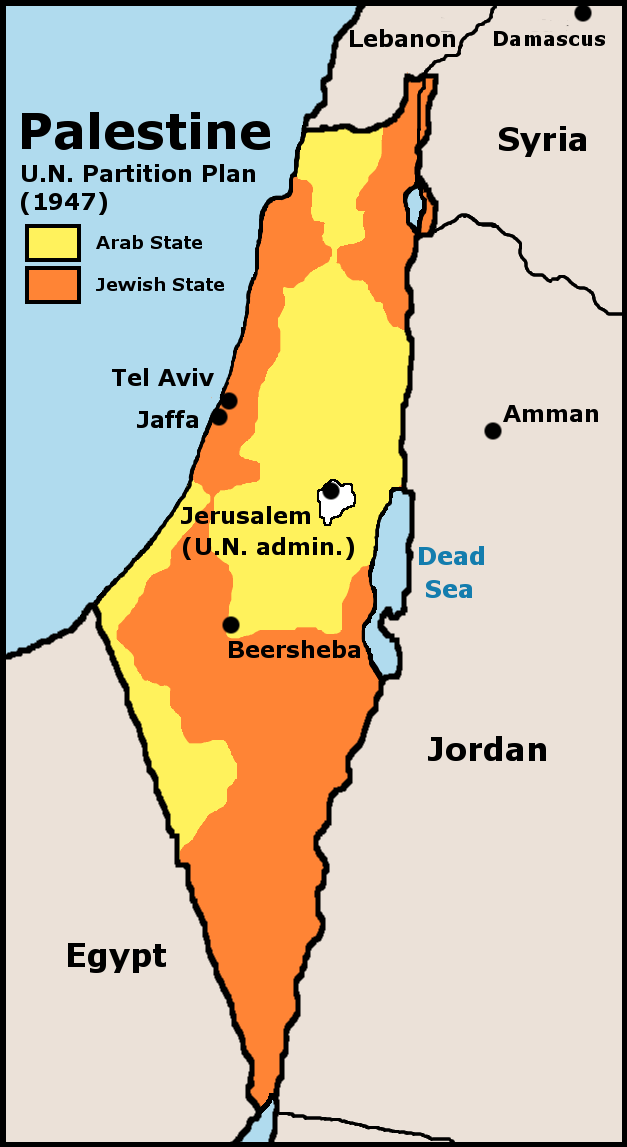
The general assembly of the United Nations votes to partition Palestine, dividing it into Jewish and Arab controlled parts, with a special international status for Jerusalem. The Jews accept the UN plan, but the Palestinians and neighbouring Arab nations indignantly reject it. [1] [12]
1948:
January - President Truman, warned by the US Department of State that a Jewish state is not viable, reverses himself on the issue of Palestine, agreeing to postpone partition and to transfer the Mandate to a trusteeship council. The British forces in Palestine side with the Arabs and attempted to thwart the Jewish attempts to arm themselves. [12]
March - The Haganah receives the first clandestine shipment of heavy arms from Czechoslovakia. The Haganah goes on the offensive and, in a series of operations carried out from early April until mid-May, successfully consolidates and creates communications links with those Jewish settlements designated by the UN to become the Jewish state. [4] [12]
The Israelis begin the systematic occupation of Palestinian, expelling the inhabitants. This is the ethnic cleansing of Palestine. They subsequently seek to erase these events from their history. [160]
Weizmann convinces Truman to reverse himself again and pledge his support for the proposed Jewish state. [12]
April - Begin's Irgun kill 250 Arab civilians at the village of Dayr Yasin near Jerusalem. The news precipitates a flight of the Arab population from areas with large Jewish populations. [12] [337]
May - Zionist also use chemical weapons against the population of Acre. They lay siege to the city and poison its water supply with typhoid. A similar attack on Gaza is foiled. [132]
The new Jewish state, State of Israel, is proclaimed by the Jewish Provisional State Council. Chaim Weizmann becomes president, and the Zionist leader David Ben-Gurion the new prime minister. The secret Jewish army, Haganah, is declared as the new army of Israel. On the following day Britain relinquishes the Mandate and the United States announced de facto recognition of Israel. Soviet recognition is accorded on May 18. [2] [12]
The first act of the Provisional Council of State is to declare null and void the restrictions on Jewish immigration imposed by British authorities. Israeli officials estimate that as of May 15, 1948, about 650,000 Jews live in the area scheduled to become Israel under the November 1947 UN partition proposal. [12]
Arab military forces begin their invasion of Israel on May 15. Initially these forces consist of approximately 8,000 to 10,000 Egyptians, 2,000 to 4,000 Iraqis, 4,000 to 5,000 Transjordanians, 3,000 to 4,000 Syrians, 1,000 to 2,000 Lebanese, and smaller numbers of Saudi Arabian and Yemeni troops, about 25,000 in all. Israeli forces composed of the Haganah, such irregular units as the Irgun and the Stern Gang, and women's auxiliaries number 35,000 or more. By October 14, Arab forces deployed in the war zones have increased to about 55,000, including not more than 5,000 irregulars of Hajj Amin al Husayni's Palestine Liberation Force. The Israeli military forces have increased to approximately 100,000. Except for the British-trained Arab Legion of Transjordan, Arab units were largely ill-trained and inexperienced. Israeli forces, usually operating with interior lines of communication, include an estimated 20,000 to 25,000 European World War II veterans. [2] [12]
The UN Security Council establishes the Truce Commission headed by a UN mediator, Swedish diplomat Folke Bernadotte. [12]
June - The UN commission arranges a ceasefire which lasts from June 11 to July 8. [12]
July - The UN commission arranges a ceasefire which lasts from July 19 to October 14. [12]
September - Folke Bernadotte is assassinated in Jerusalem. He is succeeded by Ralph Bunche, an American. [12]
1949:
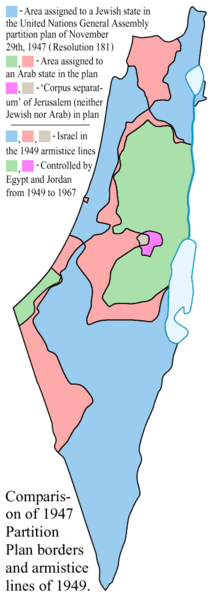
January-February - Egypt declares that the agreement on cease fire, is not an acceptance of the state of Israel. Jewish forces hold the area that is to define Israel's territory until June 1967, an area that is significantly larger than the area designated by the UN partition plan. The Israeli territory has increased from the 15,500 km² that the UN-resolution of 1947 gave them, to 20,700 km². The part of Palestine remaining in Arab hands is limited to that held by the Arab Legion of Transjordan and the Gaza area held by Egypt at the cessation of hostilities. The area held by the Arab Legion is subsequently annexed by Jordan and is commonly referred to as the West Bank. Jerusalem is divided. The Old City, the Western Wall and the site of Solomon's Temple, upon which stands the Muslim mosque called the Dome of the Rock, remains in Jordanian hands; the New City lies on the Israeli side of the line. There had been 800,000 Arabs living in the area that now becomes Israel, and only 170,000 have been able to stay. The remaining hundreds of thousands, move into refugee camps in neighbouring countries. Although the West Bank remains under Jordanian suzerainty until 1967, only two countries, Britain and Pakistan, grant de jure recognition of the annexation. [2] [12]
February - An armistice agreement is concluded with Egypt. [12]
March - An armistice agreement is concluded with Lebanon.
April - An armistice agreement is concluded with Transjordan. By now fifty-three nations, including Britain, have recognized of the State of Israel. [12]
May - the UN General Assembly, on recommendation of the Security Council, admits Israel to the UN. [12]
July - An armistice agreement is concluded with Syria. [12]
According to British Mandate Authority population figures in 1947, there were about 1.3 million Arabs in all of Palestine. Between 700,000 and 900,000 of the Arabs lived in the region eventually bounded by the 1949 Armistice line, the so-called Green Line. By the time the fighting has stopped, there are only about 170,000 Arabs left in the new State of Israel. By the summer of 1949, about 750,000 Palestinian Arabs are living in squalid refugee camps, set up virtually overnight in territories adjacent to Israel's borders. About 300,000 live in the Gaza Strip, which is occupied by the Egyptian army. Another 450,000 have become unwelcome residents of the West Bank of the Jordan, recently occupied by the Arab Legion of Transjordan. [12]
The Arabs remaining inside Israel become, in theory, citizens with equal rights to the Jewish population. In reality Arab land is confiscated to make way for Jewish immigrants; foreign economic aid goes to the Jewish economy and 90% of the Arabs are placed under military government. The military government covers three zones: the Northern Area (or Galilee Area), the Little Triangle near the border with Jordan and much of the Negev desert. In these zones movement is restricted and the military have powers of arbtrary arrest, imprisonment, seizure of property and expulsion. [12]
The Ministry of Defense also create "protected zones" adjacent to some of Israel's borders from which residents are expelled. Such areas cover "almost half of Galilee, all of the Triangle, an area near the Gaza Strip, and another along the Jerusalem-Jaffa railway line near Batir". Land made vacant in this way is given to Jewish settlers to farm. [12]
Another measure enacted by the Knesset allows the seizure of up to 40% of land in any region for "security reasons" which is then transfered to Jewish settlers. Between 1948 and 1953, about 370 new Jewish settlements are built, and an estimated 350 of the settlements are established on what is termed abandoned Arab property. [12]
According to Don Peretz, an American scholar, by 1954 "more than one-third of Israel's Jewish population lived on absentee property, [land belonging to Arabs who have fled, or which has been confiscated] and nearly a third of the new immigrants (250,000 people) settled in the urban areas abandoned by Arabs." [12]
1950:
February - The Israeli government discreetly negotiates a draft treaty with King Abdullah of Transjordan, including a five-year nonaggression pact, open borders, and free access to the port of Haifa. [12]
April - King Abdullah of Transjordan annexes the West Bank and East Jerusalem, thus creating the united Hashemite Kingdom of Jordan. Ben-Gurion acquiesces because he thinks this will mean an end to independent claims on Israeli territory and material claims on confiscated Arab territory. [12]
July - The Knesset passes the Law of Return, which states that "Every Jew has the right to come to this country as an olah (new immigrant)." [12]
Due to the heavy immigration, the Israeli economy faces serious difficulties. Aid is provided by Jewish organizations around the world, and the US government. [2]
1951:
July - King Abdullah of Transjordan is assassinated. [12]
December - Between May 1948 and December 31, 1951, approximately 684,000 Jewish immigrants have entered the new state, thus providing a Jewish majority in the region for the first time in the modern era. The largest single group of immigrants consists of Jews from Eastern Europe; more than 300,000 people have come from refugee and displaced persons camps. Many of the non European immigrants are less well educated, are poor and come from very different cultures to the European immigrants; they are looked down on by the established Israeli groups. [12]
From the end of 1951 the Suez Canal and the Strait of Tiran (at the southern end of the Gulf of Aqaba, where it opens into the Red Sea) are closed to Israeli shipping. [12]
1953:
November - Ben-Gurion tenders his resignation, and the less militaristic Moshe Sharett takes over as prime minister. [12]
1954:
Defense Minister Pinchas Lavon authorizes intelligence chief Benjamin Gibly to launch Israeli spy rings in Cairo and Alexandria in an attempt to embarrass Egyptian president Gamal Abdul Nasser. The Egyptians, however, catches and later executes the spies, and the affair proves to be a major embarrassment to the Israeli government. It is known as the Lavon affair. [12]
1955:
February - Ben-Gurion returns to the Ministry of Defense, and with the malleable Sharett still as prime minister is able to promote his hard-line defense policy. This position results in a number of raids against the Egyptians in response to attacks on Israeli settlements originating from Egyptian-held territory. [12]
October - The biggest concern of the Israeli government is now the rising power of Nasser of Egypt. Nasser signs an agreement to buy arms from the Soviet Union and Czechoslovakia, while President Dwight D. Eisenhower refuses to supply Israel with weapons. [12]
1956:
July - Egyptian nationalist hero Gamal Abdel Nasser nationalises the Suez canal, provoking a disastrous military response by Britain and France. [1]
October - Britain, France and Israel collude to seize control of the canal. Israel attacks Egypt and British and French troops move in ostensibly to protect Western shipping. The IDF routs the Egyptian army at Gaza. (also see Egypt). [2] [12]
Israel police massacre 47 Palestinian civilans, including women and children in the village of Kafr Qassem. [187]
November - French and British forces take over the Suez canal area. After intense pressure from the UN, the Soviet Union and the Eisenhower administration, which is worried about the threat of Soviet military involvement, the European powers accede to a cease-fire. Towards the end of the year the three countries had left Sinai, but Israel still held forces in Gaza. [2] [12]
France is, at this point, Israel's main arms supplier. [6]
In the late 1950s, a new flood of 400,000 mainly undereducated Moroccan, Algerian, Tunisian, and Egyptian Jews immigrate to Israel following Israel's Sinai Campaign. [12]
1957:
March - Israel leaves Gaza, after USA had promised help to keep the Gulf of Aqaba open for ships calling at Israel. Although Israel is forced to withdraw, Ben-Gurion deems the war a success: the raids from Gaza cease, UN peacekeeping forces separate Egypt and Israel, greater cooperation with France has led to more arms sales to Israel and the building of a nuclear reactor, and, most importantly, the army's performance, to him, vindicates his view on the centrality of the IDF. [2] [12]
During the Duvalier family dictatorship of Haiti, Francois "Papa Doc, 1957-1971 and Jean-Claude "Baby Doc", 1971-1986, most military aid from the US to Haiti is routed through Israel, sparing Washington any embarrassing questions about supporting such brutal governments. [11]
1958:
Britain sells Israel 20 tonnes of heavy water, which Israel almost certainly uses in its nuclear weapons development programme. [15]
1961:
Adolf Eichmann, one of the main architects of Hitler's final solution, is captured in a daring Mossad operation in Argentina, and smuggled back to Israel. He faces a dramatic trial - the first ever to be televised - and is sentenced to death for genocide. He is the first and only man to be judicially executed in Israel. [1]
1964:
Israel starts diverting water from the Jordan River for its water supply. Syria responds by building its own diverting facility which Israel frequently attacks. [12]
1967:
April - Israel shoots down six Syrian planes over the Golan Heights. [12]
May 13 - The Soviet Union, wanting to involve Egypt as a deterrent to an Israeli initiative against Syria, misinforms Nasser that the Israelis are planning to attack Syria on May 17 and that they have already concentrated eleven to thirteen brigades on the Syrian border for this purpose. In response Nasser puts his armed forces in a state of maximum alert, sends combat troops into Sinai, notifies UN Secretary General U Thant of his decision "to terminate the existence of the United Nations Emergency Force (UNEF) on United Arab Republic (UAR) soil and in the Gaza Strip," and announces the closure of the Strait of Tiran. [12]
June 5 - Israel attacks the Egyptian forces, destroying nearly the entire Egyptian Air Force on the ground. King Hussein of Jordan, misinformed by Nasser about Egyptian losses, authorizes Jordanian artillery to fire on Jerusalem. Subsequently, both the Jordanians in the east and the Syrians in the north are quickly defeated. [12]
During the "Six Day War" Israel attacks the USS Liberty, a US Navy surveilance vessel, killing 34 US servicemen. The US government accepts the Israeli explanation of mistaken identity despite overwhelming evidence to the contrary. [75] [164]
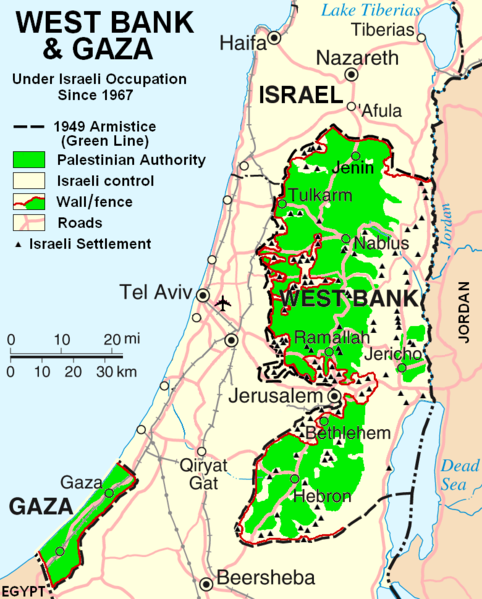
This "Six Day War" is a watershed event in the history of Israel and the Middle East. After only six days of fighting, Israel has radically altered the political map of the region. By June 13, Israeli forces have captured the Golan Heights from Syria, Sinai and the Gaza Strip from Egypt, and all of Jerusalem and the West Bank from Jordan. The new territories more double the size of pre1967 Israel, placing under Israel's control more than 1 million Palestinian Arabs. In Israel, the ease of the victory, the expansion of the state's territory, and the reuniting of Jerusalem, the holiest place in Judaism, permanently alters political discourse. In the Arab camp, the war significantly weakens Nasserism, and leads to the emergence of the Palestine Liberation Organization (PLO) as the leading representative of the Palestinian people and effective player in Arab politics. [2] [12]
The victory and especially the capture of Jerusalem unleashes a wave of religious nationalism throughout Israel. The war is widely viewed in Israel as a vindication of political Zionism. The Eshkol government follows a policy with respect to the territories, which is continued under future governments: on the one hand, it states a willingness to negotiate, while on the other, it lays plans to create Jewish settlements in the seized territories. Israel's own internal advice states this to be illegal under international law, but they proceed anyway. [12] [16]
The Arab states reject outright any negotiations with the Jewish state. At Khartoum, Sudan, in the summer of 1967, the Arab states unanimously adopt their famous "three nos": no peace with Israel, no recognition of Israel, no negotiation with Israel concerning any Palestinian territory. The stridency of the Khartoum resolution, however, masks important changes that the June 1967 War causes in inter-Arab politics. At Khartoum, Nasser pledges to stop destabilizing the region and launching acerbic propaganda attacks against the Persian Gulf monarchies in exchange for badly needed economic assistance. This means that Egypt, along with the other Arab states, will focus on consolidating power at home and on pressing economic problems rather than on revolutionary unity schemes. After 1967 Arab regimes increasingly view Israel and the Palestinian problem not as the key to revolutionary change of the Arab state system, but in terms of how they affect domestic political stability. The Palestinians, who since the late 1940s have looked to the Arab countries to defeat Israel and regain their homeland, are radicalized by the 1967 defeat. The PLO, an umbrella organization of Palestinian resistance groups led by Yasir Arafat's Al Fatah, move to the forefront of Arab resistance against Israel. Recruits and money poured in, and throughout 1968 Palestinian guerrillas launch a number of border raids on Israel that add to the organization's popularity. The fedayeen (Arab guerrillas) attacks bring large-scale Israeli retaliation, which the Arab states are not capable of counteracting. The tension between Arab states' interests and the more revolutionary aspirations of the Palestinian resistance foreshadows a major inter-Arab political conflict. [12]
The PLO establishes in Jordan its major base of operations for the war against Israel. Throughout the late 1960s, a cycle of Palestinian guerrilla attacks followed by Israeli retaliatory raids against Jordan causes much damage to Jordan. [12]
November - The The United Nations security council passes resolution 242, calling for "withdrawal of Israeli armed forces from territories occupied in the recent conflict" for the termination of the state of belligerency, and for the right of all states in the area "to live in peace within secure and recognized boundaries." It is still waiting. [1] [12] [13]
The US becomes Israel's primary supplier of arms and military aid. [5]
1968:
The nascent Palestine Liberation Organisation adopts its national charter, insisting that Palestinians everywhere have a right to their own homeland. [1]
1969:
February - With Israeli troops situated on the east bank of the Suez Canal, the canal being closed to shipping, and Israel occupying a large piece of Egyptian territory. Nasser responds by maintaining a constant state of military activity along the canal, the so called War of Attrition, between February 1969 and August 1970. Given the wide disparity in the populations of Israel and Egypt, Israel can not long tolerate trading casualties with the Egyptians. The Israeli government, now led by Golda Meir, pursues a policy of "asymmetrical response" - retaliation on a scale far exceeding any individual attack. Hoping to use Egypt's superiority in artillery to cause unacceptable casualties to Israeli forces dug in along the canal, Nasser orders Egyptian guns to begin a steady pounding of the Israeli positions. Israel responds by constructing the Bar-Lev Line, a series of fortifications along the canal, and by using the one weapon in which it has absolute superiority, its air force, to silence the Egyptian artillery. Having accomplished this with minimal aircraft losses, Israel embarks on a series of deep penetration raids into the heartland of Egypt with its newly acquired American-made Phantom bombers. By January 1970, Israeli planes are flying at will over eastern Egypt. [12] [13]
Yasser Arafat is elected chairman of the PLO. [1]
November - Israel rejects the "Rogers Plan", a peace plan proposed by US secretary of state William Rogers to settle the war between Israel and Egypt. [12]
1970:
January - Israeli fighter planes made their first deep penetration into Egypt. Following the Israeli attack, Nasser goes to Moscow requesting advanced surface-to-air missiles (SAMs) and other military equipment. After some wavering, the Kremlin commits itself to modernizing and retraining the Egyptian military. [12]
July - Israeli fighter planes shoot down four Egyptian planes flown by Soviet pilots about thirty kilometers west of the canal. [12]
August - Fearing Soviet retaliation, and uncertain of American support, Israel accepts a cease-fire [12]
September - After militant factions of the PLO (who previously had stated that "the road to Tel Aviv lies through Amman") hijack four foreign planes and force them to land in Jordan, King Hussein decides it is time to act. Throughout September the Jordanian military launch an attack to push the PLO out of Jordan. Jordan's attack on the PLO leads to an escalation of Syrian-Israeli tensions. After the PLO are expelled from Jordan they base themselves in southern Lebanon from where they launch attacks on northern Israel. [12]
President Richard M. Nixon increasingly views Israel as an important strategic asset, and the Rogers Plan is allowed to die. [12]
While negotiating a cease-fire to the conflict in Jordan, Nasser dies of a heart attack. [12]
1971:
The Black Panthers is founded. This is a protest movement of Oriental Jews (those of African or Asian origin) who suffer much lower living conditions than Jews of European origin. [12]
February - The new Egyptian president, Anwar as Sadat, believes, just as Nasser did towards the end of his life, that Egypt's acute economic and social problems are more pressing than the conflict with Israel. Sadat believes that by making peace with Israel Egypt could reduce its huge defense burden and obtain desperately needed US financial assistance. He realizes, however, that before some type of arrangement with Israel can be reached, Egypt will have to regain the territory lost to Israel in the June 1967 War. To achieve these ends, Sadat launches a diplomatic initiative aimed at exchanging territory for peace. [12]
Israel refuses the offer because they don't want to pull back from their doctrine of expansion or relinquish the all Jewish city of Yamit built in northeastern Sinai after brutally expelling the inhabitants of the region. The US gives support to the Israeli position by abandoning its support for diplomacy and instead leaving matters as they stood. [10] [12]
1972:
May - President Nixon meets Soviet president Leonid Brezhnev, and Sadat is convinced that the two superpowers will try to prevent a new war in the Middle East and that a position of stalemate--no peace, no war--has been reached. For Sadat this position is intolerable. The June 1967 War was a humiliating defeat for the Arabs. Without a military victory, any Arab leader who agreed to negotiate directly with Israel would do so from a position of extreme weakness. At the same time, the United States and the Soviet Union are urging restraint and caution. However, the United States refuses to put pressure on Israel to make concessions, and the Soviet Union, which has broken off diplomatic relations with Israel as a result of the June 1967 War, has no influence over Israel. Internally, the Egyptian economy is being steadily drained by the confrontation with Israel. Economic problems are becoming more serious because of the tremendous amount of resources directed toward building up the military since the June 1967 War, and it is clear that Sadat will have to demonstrate some results from this policy. In the last half of 1972, there are large-scale student riots, and some journalists came out publicly in support of the students. Thus, Sadat feels under increasing pressure to go to war against Israel as the only way to regain the lost territories. [13]
Eleven Israeli athletes are murdered at the Munich Olympics. Israel vows to track down and eliminate all those responsible. All but two of the 11 identified killers or planners of the operation have since been assassinated. [1]
1973:
October - The Meir government's rejection of Sadat's peace overtures convinces the Egyptian president that to alter the status quo and gain needed legitimacy at home he must initiate a war with limited objectives. On Yom Kippur, the Jewish Day of Atonement, October 6, Syria and Egypt launch a surprise attack against Israel. In the south, waves of Egyptian infantrymen cross the Suez Canal and overrun the defense of the much touted Bar-Lev Line. In the north, Syrian forces outnumbering the Israeli defenders (1,100 Syrian tanks against 157 Israeli tanks) reach the outer perimeter of the Golan Heights overlooking the Hula Basin. In the first few days of the war, Israeli counterattacks fail, Israel suffers hundreds of casualties, and loses nearly 150 planes. Finally, on October 10 the tide of the war turns; the Syrians are driven out of all territories conquered by them at the beginning of the war and on the following day Israeli forces advance into Syria, about twenty kilometers from the outskirts of Damascus. The Soviet Union responds by making massive airlifts to Damascus and Cairo, which are matched by equally large United States airlifts to Israel. In the south, an Egyptian offensive into Sinai is repelled, and Israeli forces led by General Ariel Sharon crossed the canal to surround the Egyptian Third Army. At the urgent request of the Soviet Union, United States Secretary of State Henry Kissinger goes to Moscow to negotiate a cease-fire arrangement. This arrangement finds expression in UN Security Council Resolution 338, which calls for a cease-fire to be in place within twelve hours, for the implementation of Resolution 242, and for "negotiations between the parties concerned under appropriate auspices aimed at establishing a just and durable peace in the Middle East." Following Kissinger's return to Washington, the Soviets announce that Israel has broken the terms of the cease-fire and is threatening to destroy the besieged Egyptian Third Army. Soviet leader Leonid Brezhnev informs Nixon that if the siege is not lifted the Soviet Union will take unilateral steps. The United States pressures Israel, and the final cease-fire takes effect on October 25. [2] [12]
The war has a devastating effect on Israel. More than 6,000 troops were killed or wounded in eighteen days of fighting. The loss of equipment and the decline of production and exports as a consequence of mobilization comes to nearly US$7 billion, the equivalent of Israel's gross national product. Most important, the image of an invincible Israel that has prevailed since the June 1967 war is destroyed forever. Whereas the June 1967 war had given Israel in general and the declining Labour Party in particular a badly needed morale booster, the events of October 1973 shake the country's self-confidence and cast a shadow over the competence of the Labour elite. [2] [12]
Israel's vulnerability during the war leads to another important development: its increasing dependence on United States military, economic, and diplomatic aid. The war sets off a spiraling regional arms race in which Israel is hard pressed to match the Arab states, which are enriched by skyrocketing world oil prices. The vastly improved Arab arsenals force Israel to spend increasingly on defense, straining its already strapped economy. The emergence of Arab oil as a political weapon further isolates Israel in the world community. The Arab oil boycott that accompanies the war and the subsequent quadrupling of world oil prices dramatizes the West's dependence on Arab oil production. Evidence of this dependence is reflected, for example, in the denial of permission during the fighting for United States transport planes carrying weapons to Israel to land anywhere in Europe except Portugal. [12]
The first direct Israeli-Egyptian talks following the war dealt with stabilizing the cease-fire and supplying Egypt's surrounded Third Army. Following these talks, Kissinger begins his highly publicized "shuttle diplomacy," moving between Jerusalem and the Arab capitals trying to work out an agreement. [12]
1974:
January - Kissinger, along with Sadat and Dayan, devise the First Sinai Disengagement Agreement, which calls for thinning out forces in the Suez Canal zone and restoring the UN buffer zone. The published plan is accompanied by private (but leaked) assurances from the United States to Israel that Egypt would not interfere with Israeli freedom of navigation in the Red Sea and that UN forces would not be withdrawn without the consent of both sides. Following the signing of this agreement, Kissinger shuttles between Damascus and Jerusalem, finally attaining an agreement that calls for Israel to withdraw from its forward positions in the Golan Heights, including the return of the Syrian town of Al Qunaytirah. The evacuated zone is to be demilitarized and monitored by a UN Disengagement Observer Force (UNDOF). [12]
With the ghost of the Yom Kippur War, and facing the defeat in the parliamentary elections, Golda Meir is not capable of establishing a new government, and resigns. Yitzhak Rabin becomes the new prime minister. [2]
June - After the signing of the Israeli-Syrian Disengagement Agreement in June, the public mood in Israel shifts against concessions. In part, Israel's hardened stance is a reaction to the 1974 Arab summit in Rabat, Morocco. At that summit, both Syria and Egypt supported a resolution recognizing the PLO as the sole representative of the Palestinian people. The Israeli public view the PLO as a terrorist organization bent on destroying the Jewish state. Throughout 1974 Palestinian attacks increase; in the summer alone there are attacks in Qiryat Shemona, Maalot, and Jerusalem. [12]
In Washington, President Gerald R. Ford, facing a recalcitrant Israel and under pressure from the pro-Israel lobby, decides to sweeten the offer to Israel. The United States pledges to provide Israel US$2 billion in financial aid, to drop the idea of an interim withdrawal in the West Bank, and to accept that only cosmetic changes could be expected in the Second Syrian-Israeli Disengagement Agreement. In addition, in a special secret memorandum Israel receives a pledge that the United States would not deal with the PLO as long as the PLO failed to recognize Israel's right to exist and failed to accept Security Council Resolution 242. [12]
August - US intelligence reports that Israel has produced nuclear weapons. [139]
September - Israel signs the Second Sinai Disengagement Agreement, which calls for Israel to withdraw from the Sinai passes, leaving them as a demilitarized zone monitored by American technicians and the UNEF. [12]
1975:
During the Lebanese civil war Israel reportedly spends $150 million equipping and training the Maronite Phalange Party's militia, making them a stronger force against the Muslim majority in Lebanon. [12]
Israel offers to sell nuclear weapons to apartheid South Africa. [339]
1976:
By this year Israel has established more than 30 illegal settlements on the West Bank. [12]
In spring municipal elections in the West Bank pro-PLO candidates win in every major town except Bethlehem. [12]
Israel's military pride is restored with the remarkable raid on Entebbe, in Uganda, in which a plane load of hijacked hostages are rescued. [1]
1977:
When not unable to refute accusations on financial irregularities in the private economy, Rabin experiences a defeat in the parliamentary elections. [2]
May - Menachim Begin becomes the new prime minister. A period of even more deterioration of the economy starts, despite new politics from Begin's conservative government. [2] [12]
The new Israeli government begins a massive settlement initiative in the occupied territories. Ariel Sharon declares the intention of settling one million Jews on the West Bank within twenty years. Many of the settlers are those convinced that the Palestinians have no place here and must be expelled. [9]
November - The president of Egypt, Anwar as-Sadat, visits Jerusalem and the peace process between Israel and Egypt starts. [2] [12]
1978:
March - After a fedayeen attack kills 37 people Israel launches Operation Litani, a massive military offensive that results in Israeli occupation of southern Lebanon up to the Litani River. [12]
June - Under intense international pressure Israel withdraws its forces from southern Lebanon. They are replaced by a UN Interim Force in Lebanon (UNIFIL). The withdrawal of Israeli troops without having removed the PLO from its bases in southern Lebanon becomes a major embarrassment to the Begin government. [12]
Every West Bank settlement is given responsibility for security in its own area. They are given arms and military equipment to do so. [9]
September - After the US cuts off military aid to Nicaragua, whose Somoza government has been found to be guilty of human rights violations, Israel sells them 98% of the weapons they use against the Nicaraguan population, from now until Somoza is ousted in July 1979. [9]
Likewise from the late 1970's to the early 1980's, when the US has officially cut off military aid to El Salvador and Guatemala because of human rights violations, the US routes military aid through Israel instead. They supply 80% of El Salvador's weaponry during this period, including napalm used against Salvadoran civilians. The Guatemalan regime is supplied with "everything from anti-terrorism equipment to transport planes", as they massacre Guatemalan indian villagers. [9] [10] [11]
1979:
March - Camp David Agreement signed between Egypt and Israel. Israeli withdrawal from Sinai starts, and goes on for the next 3 years. The second part of the agreement, which dealt with autonomy for the Palestinians on Gaza Strip and the West Bank, is never observed from the Israeli side. In fact immediately after the agreement is signed the Begin government approves two new West Bank settlements and makes plans for Israel keeping exclusive control of the West Bank's water, communications, roads, public order and immigration. [2] [12]
The agreement differs little from that offered by Sadat in 1971, had it been accepted then the 1973 war could have been averted. Nevertheless the US trumpet the agreement as a great triumph on their part. [10]
Arab leaders meet in Baghdad and denounce the Camp David Accords and the peace treaty for failing to address the Palestinian issue and they ostracize Egypt for its role in them. [12] Shlomo Ben-Ami, Israel's lead negotiator at Camp David later says "...Camp David was not the missed opportunity for the Palestinians, and if I were a Palestinian I would have rejected Camp David, as well. ..." [165]
1980:
Knesset declares the united and complete Jerusalem as capital of Israel. [2]
May - Six students of a Jewish religious school are killed by Arab gunfire. Violence ensues and there is a government crackdown on the Arab community. West Bank Jewish settlers now become increasingly violent; they are widely believed to be responsible for car-bomb attacks on the mayors of Ram Allah and Nabulus. [12]
The US has Israel, along with several other countries, supply weapons to the Moujahedeen with which to fight the Soviets in Afghanistan. [11]
1981:
April - Syrian forces, stationed in Lebanon as the major part of the Arab Defense League since the civil war, bomb and besieged Zahlah driving out the Phalangists (a Maronite group) there. In response Israel destroys two Syrian helicopters over Lebanon prompting Syria to move SAM's into Lebanon. [12] [14]
May - Israel fighters bomb a nuclear reactor in Baghdad, Iraq, claiming that this was being used to produce nuclear weapons to be used against Israel. At the time this is criticised as a violation of international law. Later, when Saddam Hussein is no longer considered a friend of the West, the action is praised. An inspection of the site after the bombing shows it was not suitable for weapons production. It is actually this attack which persuades Iraq to push forward with a nuclear weapons program. [2] [10]
June - After a Likud party win in the elections Begin's policies become even more annexationist. He appoints Ariel Sharon as minister of defence. Pro-PLO mayors in the West Bank are deposed, the mayors' National Guidance Committee is dissolved and two Arab newspapers and Bir Zeit University are shut down. The rate of increase of Jewish settlements on the West Bank is also increased. [12]
July - Israel bombs PLO encampments in southern Lebanon. [12]
As the CIA is setting up contra rebel units in Nicaragua, Israel helps by providing training and support for the first units. They continued to aid the contras as with their full knowledge Israeli mercenaries flew weapons and ammunition to Honduras to supply the contras on the Nicaraguan border. This only came to light after the Iran-contra scandal broke in 1986. [9]
In order to prolong the war between Iran and Iraq for as long as possible, Israel supplies Iran with arms, whilst the US supplies Iraq. In 1986 retired General Aharon Yariv, formerly Israel's head of military intelligence, declares "it would be a good idea if the Iran-Iraq war ended in a tie, but it would be even better if it continued". The US also supplies arms to Iran via Israel using the proceeds of these sales to purchase arms for the contra rebels in Nicaragua. This is the heart of what comes to be known as the Iran-contra scandal. Most observers agree that the idea for this arrangement was first put forward by Shimon Peres, the Israeli Prime Minister. [9]
December - Golan Heights are annexed by Israel. [2] [12]
1982:
May - Israel hands Sinai back to Egypt. The process of withdrawal is done in three stages, and meets only sporadic protests from Israeli settlers. [2] [12]
June - Israel invades Lebanon with US backing, calling the invasion Operation Peace for Galilee. About 20,000 people are killed, plus about 25,000 in the following years. Israel's excuse is the attempted assassination of its ambassador in London by the terrorist group led by Abu Nidal. The real purpose is to destroy the PLO and install a friendly regime in Lebanon. Amongst the most notorious Israeli actions during this war is the massacre of 700 to 800 Palestinian men, women and children in the refugee camps of Sabra and Shatila. UN attempts to stop the aggression of Israel are blocked by US vetoes. [10] [12] [14]
In Lebanon Hizbullah is founded, with Iranian sponsership, as a response to this invasion. They resist the Israeli occupation until Israel withdraws in 1985. [9]
1986:
Israeli nuclear technician Mordechai Vanunu discloses the existence of Israel's nuclear weapons programme. He is subsequently abducted from Italy by Israeli agents and jailed for 18 years, 12 of which are spent in solitary confinement. [78]
1987:
The Palestinian Intifada starts, where Israel first starts with brutal suppression, only to realize that this adds momentum to the Palestinian struggle. The Intifada would come to awaken liberal groups in Israel, and would be a prelude to the rudimentary peace initiatives that came in the 1990s. [2]
1988:
Jordan gives up the West Bank in favour of the Palestinian people. The West Bank has still a strong majority of Palestinians who considered towns and villages in Israel as their true homes. The West Bank is also under boundless Israeli control, which it has been since the occupation of 1967.
The Palestinian state is declared in a convention in Algiers, and a flag for the new state is presented. This new state is recognized only by states that have not recognized Israel, and it has no political power, only symbolic. [3]
1989:
Heavy immigration of Soviet Jews starts. [2]
1991:
Peace talks between Israel, the Arab countries, and the Palestinians start. Nothing materializes directly from these talks. [2]
1992:
October - An Israeli Boeing 747 crashes into an apartment building in Amsterdam. In addition to the immediate death toll, the health of hundreds of people is ruined because the plane was carrying depleted Uranium and the ingredients to manufacture enough sarin nerve gas to wipe out a major city. [64]
1993:
After secret negotiations outside Oslo in Norway, a peace treaty is outlined, involving the principle of "peace for land", the establishment of a Palestinian state in 1999 after 5 years of gradually increasing autonomy for the Palestinians in most of the West Bank and Gaza Strip. However the agreements make it clear that the Israeli settlement program is to be allowed to continue. The peace treaty is signed in Washington, USA, after that the American president, Bill Clinton, has almost succeeded in making the American public believe that he has had something to do with it. [2] [10]
After the Oslo Accord the flow of Israeli settlers to the West Bank actually increases. There are now about 200,000 settlers in the West Bank, this number will double by the end of 2002. [9]
1994:
Autonomy of Jericho on the West Bank, and of the Gaza Strip begins. The agreement is signed on 4th May, and the period of autonomy will end on 4th May, 1999. [3]
Peace treaty between Israel and Jordan.
This year saw some of the most dramatic actions against civilians on both side. An Israeli settler killed 29 Palestinians performing prayers in a mosque in Hebron. A suicide bomber from Hamas blew up a bus in Tel Aviv, leaving 22 dead and 47 injured. [2]
UK becomes a major supplier of military equipment to Israel. [5]
1995:
Palestinian land is annexed to build houses which Palestinians had no right to own or lease. [2]
Oslo 2 Agreement is signed in Washington, USA. This changes much of the content of the Oslo agreement, and settles the rules for the forthcoming peace process. The West Bank is divided into three zones, where the Palestinians only control the security in some of the larger cities. [3]
Prime minister Yitzhak Rabin is assassinated by the Jewish right-wing extremist Yigal Amir.
Shimon Peres is sworn in as new prime minister. [2]
1996:
Palestinian guerrilla attacks inside Israel, one suicide bomber in Ashqelon, killing 2, another in Jerusalem, killing 24. Borders between Israel and Palestine are closed in an Israeli retaliation. [2]
Israel launches an attack against a refugee camp in Qana, Lebanon, leaving about 100 dead, many of these children. The attack was a clear military failure, as there was no military action in the area. Speculations connected the bombing to the ongoing electorate in Israel, and for a short period the killings increased the popularity of Shimon Peres. [2]
When the general secretary of the UN, Boutros-Ghali, insists on publishing the findings of a UN inquiry into the attack, the US government is angry and the following year has Boutros-Ghali replaced with a more compliant Kofi Annan. [9]
Benjamin Netanyahu wins the first direct prime minister elections of Israel, with a margin of 29,457 votes over his only contender, the ruling prime minister Shimon Peres. [2]
Netanyahu lifts a ban imposed in 1992 on new Jewish settlements in occupied Palestine. The new politics intended to increase the Jewish presence by 50,000, a relative increase of 35%. [2]
Netanyahu's government initiates building of new apartments that are reserved for Jews alone, in the Palestinian owned territory called Har Homa in Hebrew, and Jabal Abu Gnayn in Arabic. With this settlement East Jerusalem will be surrounded by all-Jewish housing estates. [2]
Richard Perle and Douglas Feith, who later become key members of the US Bush administration, coauthor a paper advising Natanyahu to make "a clean break from the peace process". [9]
Arab countries reimpose boycott of Israel, as a retaliation of what they consider Israeli violations of the Oslo 2 Agreement. [2]
National elections in Palestine, which foreign observers declare as free and fair. The elections have a good turnout, and Yassir Arafat is elected president. [3]
Germany and France begin major arms supply to Israel. [5]
1997:
Douglas Feith, later to be US president Bush's undersecretary of defense, writes a paper calling for Israel to reoccupy "the areas under Palestinian Authority control" even though "the price in blood would be high". [9]
This becomes a year of minimal progress in the peace negotiations between Palestine and Israel, thanks much to the hard line politics of Israeli prime minister Benjamin Netanyahu. He initiates the establishment of new Jewish-only settlements on the West Bank, which destroy connections between the Palestinian territories and East Jerusalem. Arafat responded with less willingness to conduct talks with Israel, and the Palestinians resumed their fights, similar to how the situation had been during the Intifada. [3]
The newly elected prime minister of Britain, Tony Blair, appoints Jewish business man Michael Levy, a man with strong Israeli connections, as his "special envoy" to the Middle East. [8]
1999:
The scandal-prone government of Binyamin Netanyahu is replaced in general elections by a Labour-led coalition headed by former army chief Ehud Barak, who promises to deliver a final peace settlement with the Palestinians. [1]
The UK supplies £11.5 million worth of arms to Israel. [7]
2000:
The Palestinian Central Council ratifies a plan for officially declaring a Palestinian state on September 13, even if no final peace agreement has been reached with Israel. Polls among Palestinians show pessimism over the possibility of having a final peace agreement with Israel by September 13. A majority also believes that a Palestinian state will not be declared on this date. 1/3 were in favour of direct confrontation or a new intifada, while another 1/3 supported the Palestinian leadership. [3]
September 13th passes, but no independence is declared, as no final peace agreement has been signed with Israel. [3]
September - A new intifada breaks out, following Ariel Sharon's provocative visit to a Muslim holy site in Jerusalem/Al Quds. Over the following 3 months, many small clashes between stone throwing Palestinian youths and armed Israeli military, leaves hundreds dead. There are also killings of Israelis performed by armed Palestinian guerilla, as well as killings by illegal Jewish settlers against Palestinians. [3]
In the first month of the intifada, according to IDF accounting, the ratio of Palestinian to Israeli dead is almost twenty to one. [10]
The UK supplies £12 million worth of arms to Israel. [7]
December - The US vetoes a UN Security Council resolution calling for dispatching of international monitors in order to reduce the violence. [10]
2001:
The death toll mounts inexorably. By the end of the year more than 1000 are dead, the overwhelming majority of them Palestinians. Successive US attempts to secure a ceasefire, initiated by Sen George Mitchell and CIA director George Tenet, come to nothing. America's new president, George Bush, endorses the idea of a Palestinian state, but cools towards Yasser Arafat in the wake of the September 11 atrocities in New York and Washington. Israel, now led by Ariel Sharon, mounts ferocious assaults on the Palestinian territories, and describes Arafat as an "irrelevance". [1]
Supply of military equipment from the UK to Israel almost doubles to £22.5 million. [5] [7]
May - The UK media is shown to be grossly biased in favour of Israel. [7]
June - The Health Information and Policy Institute concludes that 90% of Palestinians killed or wounded in the second intifada have been civilians, 45% have been under 18 years old, 60% were shot while in their homes, schools or workplaces. [8]
August - Israel admits that contrary to assurances given by the Israel government, they are using UK supplied military equipment in operations against Palestinians in the West Bank, but the UK continues to supply them. [7] [8]
November - Israeli agents assassinate Hamas leader Mahmud Abu Hunud. The inevitable response of Palestinian suicide bombings is used as an excuse by the Israeli's to mount an attack on the Occupied Territories which all but destroys the Palestinian Authority and Arafat's political base. The UK government had been shown plans for such an attack some months earlier, they raised no objections then and nor do they now. [8]
December - The UK abstains from a resolution criticising Israel, saying that the wording did not sufficiently criticise the Palestinians. [7]
2002:
February - More than 100 Israeli reservists publish a statement saying they refuse to continue serving in the West Bank and Gaza Strip because Israel's policies there involve "dominating, expelling, starving and humiliating an entire people". [9]
April - Israeli forces kill 52 Palestinians in the Jenin refugee camp. Israel commits war crimes in the process, according to Human Rights Watch. Many civilians are "killed wilfully and unlawfully". They use tanks, armoured personnel carriers and missile strikes from US supplied Apache helicopter gunships. They also demolish dozens of houses using bulldozers. In one incident they shoot a crippled Palestinian, Kemal Zughayer, in his wheelchair as he waves a white flag, then run over his body with a tank. All this supposedly to fight a few dozen men with automatic rifles. Israel blocks emergency medical access to the camp and fires on Red Cross ambulances. The UK voices criticism of Israel's actions, but helps block any meaningful international response. The US's Colin Powell is sent to "bring peace", but delays his arrival until the Israelis have finished the slaughter and withdrawn. [7] [8] [9] [10]
The UK continues to supply military equipment to Israel for use against the Palestinians, despite the UK government expressing concerns over this use. [7]
December - The US votes against a UN General Assembly resolution reiterating the opposition to Israel's effective annexation of Jersulem in defiance of Security Council resolutions going back to 1968. This formally reverses the long standing official US position on the status of Jerusalem and virtually eliminates the possibility of a political settlement. [10]
2003:
Political and military ties between India, the US and Israel grow. [10]
Israel begins to construct its "security fence" on Palestinian land in the West Bank. In reality this consists of a concrete wall eight meters high, wire fences and electronic sensors, ditches foru meters deep on either side, a dirt path to reveal footprints, an area into which entry is forbidden, a two lane road for army patrols and watchtowers and firing post every 200 meters along its length. It is estimated that between 95,000 and 200,000 Palestinians will be directly adversley affected by this "fence". It will split the Palestinian state into isolated enclaves, without access to the Jordan Valley or much of the fertile land that is theirs. [9] [10]
Two Israeli civil rights attorneys calculate that during the al-Aqsa Intifada, from November 2000 to April 2003, Israel has "carried out no less than 175 liqudation attempts" killing 235 people of whom 156 were suspected of crimes. These killings which would be classified as terrorist atrocities if committed by others amount to "a crime against humanity". [10]
June - Israel signs a bilateral agreement with the US whereby both signatories pledge not to hand over to the ICC nationals accused of crimes against humanity. [9]
The US establishes its "roadmap" for peace. As usual the Palestinians are required to immediately cease resistance to the Israeli occupation, but only minor demands are made of Israel. Israel is allowed to continue settlement activity until some unspecified time. The US subsidy to Israel is made dependant only on the introduction of economic reforms that "will slash public sector jobs and wages and lower taxes". [10]
2006:
January - Hamas is elected as the government of the Palestinian Authority. [191]
April - Israeli soldiers kill 36 Palestinians, including 3 children, in the West Bank and Gaza strip and arrest at least 300 this month. [17]
Israel is firing 300 shells a day into Gaza. [23]
Hamas says it is willing to recognize Israel if it withdraws from the territories occupied in 1967. [22]
May - Israel controls 98% of the water and 95% of the land in the Jordan Valley, which makes up 30% of the West Bank. [18]
Microsoft helps Israel in its attempt to jail Mordechai Vanunu, the whistleblower who leaked some of Israel's nuclear secrets to the foreign press. [25]
June - A South African union joins the boycott of Israel, calling it an apartheid nation. [19]
Israel has fired 6,000 shells into Gaza over the last two months, killing many civilians, including a family they shelled on the beach. [20] [24]
Over 99% of Gaza children are suffering trauma due to Israeli attacks. In the past four years 621 children have been killed by the Israelis. A quarter of children under five are acutely or chronically malnourished. All this and more is made possible by US support. [21]
Israeli forces enter Gaza after first destroying three bridges and a power station, leaving much of the strip without electricity. The US provides political support. [26]
July - An rally by Israelis opposes the invasion of Gaza and denounces the Israeli government as war criminals. [27]
The Swiss government, the depository state of the Geneva conventions, says Israel has clearly violated international law by imposing collective punishment on the Palestinians. [28] A UN envoy also says Israel has violated the "most fundamental norms of humanitarian law and human rights law". [29] But the EU and US do nothing. [30]
The Congress of South African Unions condemns the "apartheid Israel state" as being worse than that formerly in South Africa. [31]
US and European companies continue to profit from the Israeli occupation. [33]
Hezbollah guerrillas seize two Israeli soldiers and Israel invades Lebanon, launching a huge air and ground offensive. The media are soon claiming that Hezbollah crossed into Israel to capture the soldiers, but early reports say they were captured during clashes on the border. It is also shown that Israel had planned the attack on Lebanon in 2004, with the approval of the US. Later testimony by the Israeli president shows that the plan for war with Lebanon was indeed made far in advance. Israel attacks indiscriminately, including attacking a UN camp and ICRC ambulances and uses illegal weapons, while the West does nothing. The UN security Council even rejects a call for a cease fire. Israel is later accused of war crimes for targetting civilians and civilian infrastructure. [32] [34] [35] [36] [37] [38] [45] [46] [48] [53] [94]
The US and UK oppose a ceasefire while supplying arms to Israel to continue the war. [39] [58]
August - Israeli attacks on Gaza continue. [40] As do attacks on Lebanon, with the Israeli forces killing far more civilians than combatants. [41] They prevent aid from reaching those in desperate need and attack convoys of fleeing civilians. [42] [44] [52]
14th - Ceasefire in the Lebanon conflict begins. Some 1,000 Lebanese, mostly civilians, and 157 Israelis, 114 of them soldiers, have died in the 34-day conflict. [43] There is also extensive damage to the countires infrastructure and housing. [57]
Thousands of unexploded US supplied cluster bombs take their toll on returning refugees. Cluster bombs are not supposed to be used in urban areas, but Israel used them everywhere. As one IDF commander says "What we did was insane and monstrous, we covered entire towns in cluster bombs". [50] [56] [59] Hizbollah is also accused of war crimes for targeting civilians with rocket fire. [60]
Hizbollah's popularity increases in Southern Lebanon and Beirut as they begin to take on the task of reconstruction. [51]
Israel have now arrested a quarter of all Palestinian MP's. [47]
The population of Gaza continues to suffer from the affects of having their power station bombed out of action by Israel and from being blockaded by Israel. [49] [55]
The US and UK help restock Israel's weapons. [54]
September - Continued Israeli attacks on Gaza take a heavy civilian toll, in addition to the suffering caused by turning the Gaza strip into a prison where life is intolerable, according to a UN human rights envoy. In any other country, he observes, this would be called ethnic cleansing. All this the West allows and augments by withdrawing funds for Gaza. [61] [62]
Meanwhile a survey shows that most Israelis would support their government negotiating with Palestinian leaders, including Hamas. [63]
October - The number of Israeli roadblocks in the West Bank has been incresed by 40% in the last year. There are now 528 checkpoints and obstacles in the West Bank making travel within Palestine harder than ever for Palestinians. [65]
The UK Government criticizes Hizbollah in its annual human rights report, but totally fails to mention Israel's war on Lebanon. [66]
The US trains Fatah forces to fight against those of Hamas. [67]
November - Israeli forces launch further attacks in the Gaza strip killing at least 37 in 4 days. [68]
Israeli forces shell Palestinian homes in Beit Hanoun, killng at least 18 people as they sleep. [69] [70]
A study by Physicians for Human Rights shows that in four months Israeli forces have killed 247 Palestinians in Gaza; 155 of them civilians and 57 of them children. [71]
The US vetoes a UN security Council resolution condemning Israeli actions in Gaza. The UK government is more concerned about damage done to a first world war cemetry near Beit Hanoun. [72] [73] [74]
26th - Israeli forces withdraw from Gaza and a ceasefire starts. [76]
Israel decides to deny water to hundreds of Bedouin families. [77]
December - The US decides to doubles its military stockpiles held in Israel, stockpiles that Israel can access during an "emergency". The last time it accessed them was in its recent war against Lebanon. [79]
The US trains Fatah forces to fight Hamas. [80]
Hamas reiterates its willingness to coexist with Israel according to the 1967 borders. [81]
Israeli arms exports hit an all time high at $4.1 billion. [82]
Hamas and Fatah, who have been clashing in Gaza, agree a truce. [83]
Fatah forces are armed by the US and Egypt with Israeli approval. [84] [85]
Israeli forces are found to have killed three times as many Palestinians in 2006 as in the previous year. [86] 124 of them were children. [102]
2007:
January - In Gaza "99.4 per cent of the children we studied suffer trauma." [87]
Hosts of restrictions make life for Palestinians a daily trial. [88]
Israeli separation wall cuts off 250,000 Palestinians from the rest of the West Bank. [89]
February - 268,000 Israelis are now settled in the West Bank. [90]
A UN Human Rights Council report says Israeli laws and practices "resemble aspects of apartheid" and says In the West Bank, "residents live in fear of settler terror". [91]
The continued Israeli ban on Gaza fishermen causes great suffering. [92]
March - A group of visiting German bishops equate Israel's actions to those the Nazis. [93]
The US and EU refuse to recognise a new Palestinian unity government. They demand that the Palestinian government renounce violence, recognise Israel and accept past peace agreements, but make no corresponding demands of Israel. [95]
The US funding of Abba's forces amounts to nearly $60 million. [96]
April - Israeli chief interrogator is unabashed about torturing Palestinians. [97]
Apparently in the US its ok to raise millions of dollars for Israeli forces widely accused of war crimes. [98]
10% of Palestinian children are suffer permanent harm from malnutrition. [99]
Israel continues to hold around $600 million of Palestinian money. [100]
Hamas abandons the ceasefire with Israel after repeated Israeli violations of it. [101]
May - A US court refuses to even consider a war crimes case against an Israeli official. [103]
The Israeli cabinet approves killing more people it suspects of being Palestinian fighters. [104]
Israel carries out airstrikes on Gaza and allows US trained Fatah troops in to fight Hamas. [105]
Israel arrests attacks politicians and attacks Hamas government buildings. [106]
June - Palestinian Authority president Mahmoud Abbas forms a new illegal "emergency government" in an effort to counter Hamas (the democratically elected government), who have ousted Fatah from Gaza. [107] [108]
The US House of Representatives passes a resolution congratulating Israel for its seizure of Jerusalem in 1967. [109]
A new UN map shows the extent of the geographical restrictions placed on Palestinians in the West Bank, 40% is inaccessible to them and movement is heavily restricted elsewhere. [110]

Hamas takes control of the Gaza strip, driving out Fatah. In response Abbas dismisses the Hamas led coalition government. Gaza and the rest of the Palestinian territory are now governed seperately. [111] [112]
The US pledges to increase military funding of Israel and Israel launches another military assault on Gaza, killing civilians. [113] [114]
July - Israel transfers to the Abbas government $120 million of the over $700 million of Palestinian money that it has seized. [115]
A major British union votes to boycott Israeli products because of Israeli actions in the occupied territories. The UK government does not support the boycott. [116]
A US christian group recommends divesting from companies supporting Israel's actions against Palestinians. [117]
Hamas control restores a measure of law and order to Gaza. [118]
UK PM becomes patron of JNF. [121]
August - The US increases its military aid to Israel by 25%. [119]
Israel has driven the Palestinians in the occupied territories further into povert than ever, with the help of the US, UK and other European governments. [120]
September - Israel is making billions of dollars from the export of military and security products proven in use against Palestinians. [122]
Israel moves to impose further sanctions on the Gaza strip. [123]
October - A senior UN official condemns the UN for its partisan role in Middle East talks, bowing to US pressure and undermining any prospect of a Palestinian state. [125]
Israeli soldiers reveal their brutality in Palestine: murder, breaking bones of Palestinian children, actions of humiliation, destruction of property, robbery and theft. [126]
November - French president Sarkozy is revealed to have been recruited to help Israeli intelligence. [128]
The US congress approves $155 million of funding for an Israeli missile system. [129]
After 20 years the US drops its charges against the last of the "Los Angeles Eight", people they had accused of being terrorists because they tried to support the human rights of Palestinians and educate people in the US about their plight. [130]
Annapolis - another fake "peace conference" begun by the US government. [131]
December - The Israeli government declares itself not interested in a truce with Hamas. [133]
The years death toll: 457 Palestinians, 10 Israelis, including 92 Palestinian children, 0 Israeli children. [140]
2008:
January - The US alone objects to the UN discussing Israel at an anti racism conference. [134]
Israel refuses to hold cease fire talks with Hamas. [135]
A US report revelas that Israel has nuclear weapons with a yield of one megaton and has 200 nuclear warheads. [136]
Israeli military courts are shown to give almost automatically convict Palestinians. [137]
Gaza is forced to cut electicity supplies as Israel continues to restrict fuel supplies. [138]
Israeli forces bomb the Interior Ministry building in Gaza, reducing it to rubble. [141]
The Israeli blockade causes increased suffering in Gaza, with hospitals running short of power and sewage spilling onto the streets. [142]
Palestinian fighters blow holes in part of the border fence between Gaza and Egypt, allowing people to enter Egypt to buy food and supplies. [143]
The US prevents the UN Security Council from issuing a resolution condemning Israel's blockade of the Gaza Strip. [144]
Jews condemn Zionist atrocities in Gaza and the rest of Palestine. [146] [147]
February - After two weeks, the Egypt-Gaza border is resealed. [145]
The Egypt-Gaza border is kept closed only with the collusion of the EU. [148]
An Israeli military database shows that more than one third of Israeli settlements in the West Bank are built on land taken from private Palestinian owners. [149]
A UN report says that Palestinian terrorism is an "inevitable consequence of colonialism, apartheid or occupation" and that Israeli government policies constitute all three. [150] [154]
March - Israeli forces kill 61 Palestinians in one day during an incursion into the Gaza Strip. After six days, as the Israeli forces withdraw, the total stands at at least 116 Palestinians dead, including 22 children and 12 women. [151] [152]
The Israeli government refuses to stop building settlements on occupied land around Jerusalem. [153]
April - Residents of the Gaza Strip are dying because Israel forces refuse them permission to leave the Strip for medical treatment. [155]
Former US President Jimmy Carter describes the Israeli blockade of the Gaza Strip as a "crime and an atrocity". [156]
Israeli soldiers confess how they beat and torture Palestinians, even children. Many express their opposition to the Israeli treatment of the Palestinians. [157] [159]
Israel rejects a truce offer from Hamas. [158]
June - The US army trains Egyptian soldiers to find and destroy tunnels used to smuggle goods into the Gaza Strip. [161]
Israeli settlers are filmed attacking a Palestinian family. [162]
Palestinians are frequently banned from the beaches of the Dead Sea, the only open water accessible to them. [163]
July - Access to water in the West Bank is limited for Palestinians. They only get two thirds of the recommended international minimum. Israelis in the West Bank get 3.5 times as much. [167]
Israeli settlers fire homemade mortars at Palestinians villages. [168]
Israel's Shin Bet torture an award winning Palestinian journalist. [169]
With the help of the Palestinian Authority, Israel forces the closure of Palestinian charitable institutions in the West Bank, which may be associated with Hamas. [170]
ANC veterans say that Israeli restrictions against Palestinians are like apartheid and in some respects worse. [171] [172]
War crimes charges are files in a Spanish Court, against Israeli officials. [173]
According to the UN the unemployment rate in the Gaza Strip is the highest in the world at 45%. [174]
August - Israel's Shin Bet pressure seriously ill patients to collaborate with them in exchange for being allowed medical treatment. [175]
Israeli settlers attack UK diplomats in Hebron. [176]
Activists make a symbolic voyage to Gaza defying the Israeli seige. [177]
Israeli Bar finds that Palestinian prisoners are routinely subjected to inhumane treatment. [178] [179]
September - Israeli soldiers are filmed assaulting a bound prisoner. [180]
Israel allows Jordan to give arms to Fatah to oppose Hamas. [181]
The US approves another $330 million in arms deals for Israel. [182]
The Israeli navy is filmed firing on Palestinian fishermen. [183]
The US establishes its first permanent military presence in Israel. [184]
The US approves sale of 25 F-35 fighters to Israel. [185]
October - Israeli settlers are filmed attacking Palestinians trying to harvest olives. [186]
November - Israeli troops film themselves humiliating a bound Palestinian. [188]
Hamas again reiterate their willingness to accept a Palestinian state within the 1967 borders. [189]
The UN runs out of food for Gaza as Israel keeps borders closed. The power plant is also shut down for lack of fuel. [190]
A US court convicts charity owners on terrorism charges for supporting Hamas run welfare projects. [192]
Israel breaks the Egyptian brokered 6 month truce in Gaza, sending tanks and bulldozers into the Gaza Strip. [256]
December - Israel expels the UN human rights envoy, Richard Falk, who was investigating Israeli human rights violations. [193]
Israel launches air attacks on the Gaza Strip, killing over 380 people and injuring hundreds more. The UK and US governments refuse to demand and end to the airstrikes. The US vetoes a UN Security Council resolution calling for an end to the attacks. [195] [196] [197] [199] [200] [202]
An Israeli gunboat rams a ship trying to bring aid to Gaza. [201]
2009:
January - The US government and Barack Obama, the US president elect, refuse to condemn the Israeli massacre of Palestinians in the Gaza Strip. [198]
Thousands around the world protests against the ongoing attacks. Over 400 Palestinians are now dead. [203]
The Israeli authorities prevent the Red Cross from entering Gaza. [204]
Israel uses depleted uranium and white phosorous in its assault on Gaza. [205] [206]
Israel strikes a UN school killing at least 43 people sheltering there. They also attack ambulance crew. [207] [212]
It is revealed that the US gave Israel the green light for attacking Gaza. [208]
Egypt refuses to allow doctors into the Gaza Strip. [209]
Death toll reaches at 660, including 215 children and 98 women. [210]
Israeli forces attack a UN convoy. [211]
Egypt refuses to allow aid into the Gaza Strip. [213]
The US Senate gives its support to Israel attacks on Gaza. [214]
Israeli forces leave wounded civilians to die. [215]
Israeli forces shell a house where they have ordered about 100 people to stay, 60 to 70 are killed. [216]
Israel violates a three hour truce declared for humanitarian aid. [217]
The US abstains from a UN vote calling for a ceasefire. [218]
Israel is taking hundreds of civilians prisoner from Gaza. [219]
The president of the UN General Assembly accuses Israel of genocide. [220]
Israel bans Arab parties from the general election. [221]
Israeli forces shell a hospital and UN compound. Phosphorus shells are used in the attack and possibly Dense Inert Metal Explosive (DIME). After weeks of denials Israel admits using phosphorus. Phosphorus is also used elsewhere in attacks on Gaza. [222] [229] [231] [257]
The Israeli navy turns back a boat bringing humanitarian aid to Gaza. [223]
The president of the UN General Assembly says that Israel's assault on Gaza amounts to genocide. [224]
Israeli and US diplomats foil an attempt by the UN Security Council to condemn Israel's attack on the UN compound in Gaza. [225]
Israel and Hamas both declare a ceasefire. More than 1,400 Palestinians have been killed and 13 Israelis. More than half of the Palestinians killed were civilians, possibly as high as 92% and over 300 were children. Thousands of homes and buildings have been destroyed, 100,000 people have been displaced. The offensive was planned months in advance including the propaganda element. [226] [227] [228] [240] [269]
Israel is accused of appalling and inhuman treatment of Palestinians detained during the assault on the Gaza Strip. Israeli troops are also accused killing people waving white flags, including children. And forcing civilians into battle zones. Unmanned drones are also used, taking many civilian lives. [234] [237] [241] [253] [254] [255]
Israeli soldiers later testify to the shooting of civilians during the assault and other crimes. [248] [251] [283] [284]
Many soldiers were told and believed it to be a religious war in which they were expelling gentiles from the land given them by God. [249]
The Israeli assault has destroyed 35-60% of the farmland of the Gaza Strip, halving the amount of food that can be produced there and leaving them even more dependent on aid which Israel restricts. [239]
The BBC refuses to air a fundraising appeal for Gaza victims, other channels follow suit. [230]
The EU Aid Commissioner blames Hamas for Israel's attack on Gaza. [232]
Egypt and the EU help Israel blockade the Gaza strip. [233]
Egyptian government refuses to allow aid for Gaza from Iran to pass through Egypt. And injured Palestinian children are prevented from leaving the Gaza strip for treatment. [235] [236]
February - Israel prevents reconstruction in Gaza. [238]
Israel forces seizes another aid ship bound for Gaza. [242]
Egypt refuses to allow war crimes investigators into the Gaza Strip. [243]
Benjamin Netanyahu becomes the new Israeli prime minister. [244]
EU aid has been going to the Israeli oil company withholding fuel from Gaza. [245]
March - The EU concludes that Israel is pursuing the illegal annexation of East Jerusalem. [246]
A Gaza aid convoy is attacked in Egypt. [247]
A 1000% rise in Jewish attacks on the Arab population in Israel is reported, during 2008 compared to 2007. [250]
Calls for an investigation into Israeli war crimes increase. [252]
The US delivers a 14,000 tons of munitions to Israel. [258] [260]
April - The UN appoints Richard Goldstone, a Jewish judge from South Africa, to lead the investigation into Israeli war crimes in the assault on the Gaza Strip. [259]
The British Charities Commission has funds of over £100,000 intended for aid for Palestinians, frozen. [261]
Egypt holds hundreds of thousands of tonnes of aid intended for the Gaza Strip. [262]
The BBC condemns a report by one of its reporters, which points out the illegality of the Israeli wall and illegal Israeli settlements. [263]
The US and various European countries prevent Israel's treatment of Paleestinians being discussed at the UN conference on Racism. [264]
Population of Israel is now 7.4 million, of whom 5.593 million are Jewish, 1.498 million are Arab. [265]
Unemployment in Gaza stands at 65%. 80% of Gazans live below the poverty line and 85% are dependent on aid. [266]
May - Giving in to Israeli pressure, the UN Secretary General rejects a UN report condemning Israel for its attacks on the UN facilities in Gaza. [267]
Israeli security forces are interogating patients before allowing them to leave the Gaza Strip for treatment. [268]
Money promised to Gaza for rebuilding is not getting to them. [270]
Israel is found to have secret prisons where prisoners have been routinely tortured. [271]
Israeli troops destroy another 200,000 square metres of crops in the Gaza Strip. [272]
The US jails men for giving money to Hamas. [273]
June - Israel's "buffer zone" has taken 30% of Gaza's arable land. [274]
Israelis are taking 80% of the water in the West Bank, leaving some Palestinians with less than disaster relief levels. [275]
The UK PM, Gordon Brown, puts an Israeli lobbyist in charge of Britain's Middle East policy. [276]
Israel is selling the property of Palestinian refugees, and continues to seize Palestinian land for Israeli housing. [277] [278]
July - The US reapproves $3.8 billion of loans for Israel. [279]
Israeli forces sieze a humanitarian aid vessel bound for Gaza, whilst it is in international waters. [280]
The EU retracts its criticism of Israeli settlements. [281]
After heavy pressure, the UK cancels only 5 export licences for military goods to Israel; a tiny proportion of those approved. [282]
An aid convoy manages to enter the Gaza Strip for a second time. [285]
Israel hires people to spread Israeli propoganda on social networking web sites. [286]
Facebook removes the fan page of the Hamas prime minister. [287]
August - The Israeli government tries to silence human rights groups exposing its crimes. [288]
Palestinians with ties to the CIA are elected to the Palestinian Central Comittee. [289]
September - The UN's Goldstone report concludes that Israel is guilty of war crimes and crimes against humanity. [290] Read about the report [here. 325]
Israeli soldiers routinely mistreat Palestinian children. [291]
October - Germany supplies Israel with two more submarines. [292]
Israel tries to blackmail the Palestinian Authority into withdrawing a request to the International Criminal Court to investigate Israeli crimes during its assault on the Gaza strip. [293]
The Palestinian Authority bows to US pressure to delay a vote on the UN's Goldestone report about Israel's assault on the Gaza strip. [294] [297] They later reverse this decision in the face of public protests. [298]
The US reaffirms its agreement with Israel help keep their nuclear weapons from scrutiny. [296]
Israel continues to expand its illegal settlements in the West Bank. [295]
More Israelis refuse to serve in the military because of the oppression of the Palestinians. [299]
Israel continues to hold hundreds of Palestinians without charge. [300]
The US stalls Security Council action on war crimes during Israel's assault on the Gaza Strip, but the UN Human Rights Council officially adopts the Goldstone report on the attack, endorsing war crimes charges against both Israel and Hamas. [301] [302]
Israel continues to deny the Palestinians water. [303]
November - The US House of Representatives opposes the Goldstone report. [304]
Many Jewish groups endorse the Goldstone report. [305]
The number of deaths directly attributable to the Israeli blockade of the Gaza Strip passes 360. [306]
The UN General Assembly endorses the Goldstone Report. [307]
The EU refuses to support a plan for a Palestinian State. [308]
An Israeli judge refuses to convict a Palestinian teenager because of the discrimination in the Israeli legal system. [309]
The British political system is shown to be heavily influenced by Jewish lobbying. [310]
December - US groups raise millions of dollars to fund illegal Israeli settlements. [311]
The US helps Egypt build a steel wall along its border with the Gaza Strip, that extends 18m below ground. They are also installing equipment to detect underground movement. [312] [314]
US officials are checked for a pro-Israeli stance before being appointed. [313]
The USA gives Israel another $2.775 billion for "security". [315]
The CIA works with the PA, allegedly torturing suspected supporters of Hamas. [316]
Israel admits to stealing organs from dead Palestinians and Israelis in the 1990's. [317]
One year after Israel's assault on the Gaza Strip, almost no international aid has reached the Palestinians there. Only private citizens are helping. [318]
2010:
January - A private aid convoy gets into Gaza. [319]
Israel stops granting working permits to NGO members. [320]
Auschwitz survivor says "Israel acts like Nazis". [321]
Israel refuses to conduct an independent inquiry into its assault on the Gaza Strip. [322]
February - Israel has reportedly defrauded Palestinian workers of more than $2 billion dollars over the last four decades. [323]
US and European funded Palestinian security forces are trying to quash opposition to Fatah. [324]
And Israel tries to prevent non-violent protest against the occupation. [326]
Israel appears to be assassinating some of its opponents in the Middle East. [327]
Britain may have colluded in Israel's assassination of a Hamas official in Dubai. [328] [329]
March - The EU endorses the Goldstone Report on Israel's assault on the Gaza Strip. [330]
The Russell Tribunal finds the EU guilty of aiding Israeli war crimes and violations of human rights. [331]
The US again opposes the censuring of Israel for human rights violations. [332]
The US gives more arms to Israel, worth about $250 million. [333]
The UK's annual intelligence report shows that the UK government produced anti-Palestinian propaganda during Israel's assault on the Gaza Strip. [334]
April - An Israeli is put on trial for leaking Israeli army papers documenting the Israeli army's systematic law-breaking, including targeting civilians. [335]
The steel barrier between the Gaza Strip and Egypt proves not to be impenetrable. [336]
May - The US funds roads for Israelis only. [338]
Israeli forces attack a flotilla of vessels bringing aid to Gaza. The attack is carried out in international waters, killing 11 unarmed civilians, injuring many more and the rest captive. Israel claims self defense! Those killed were shot multiple times at close range, five of them from behind. [340] [341] [344] [345] [346]
June - Israel deports the peace activists from the hijacked aid flotilla. [342]
The US blocks UN Security Council criticism of the Israeli attack on the aid flotilla, insisting the activists should be criticised for trying to defending themselves! [343]
Israel refuses to allow an international inquiry into its attack on the aid flotilla. It will hold its own inquiry. The US approves. [347]
Under international pressure Israel makes a token adjustment to the blockade on the Gaza Strip. [348] [349]
Israel seizes oxygen machines destined for Palestinian hospitals. [350]
Some parts of the West Bank are found to be have even worse living conditions than Gaza, thanks to Israeli restrictions. [351]